Supplier of control and measuring instruments in Latvia, Estonia and Lithuania. Worldwide delivery
Supplier of control and measuring instruments in Latvia, Estonia and Lithuania. Worldwide delivery
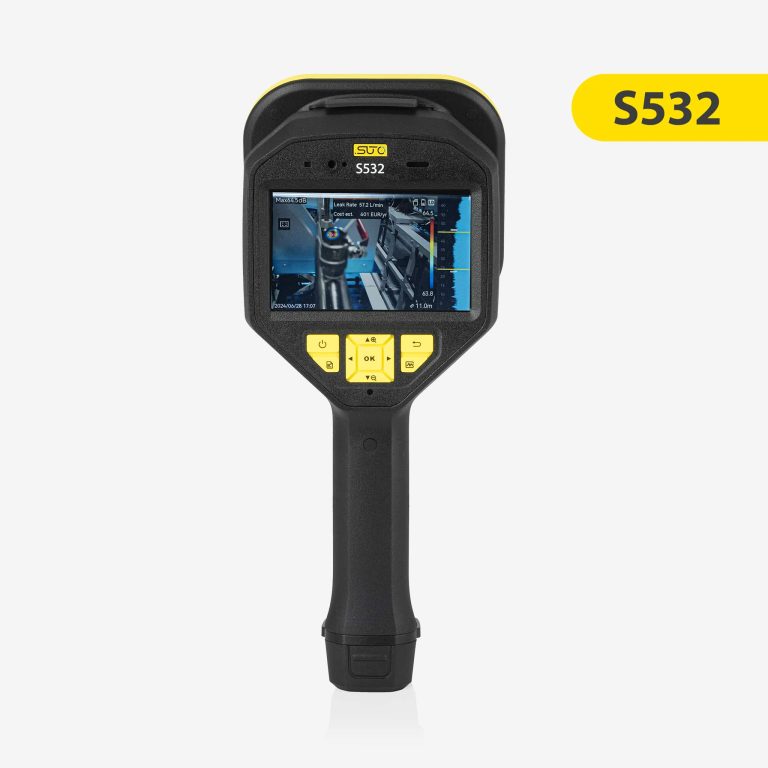
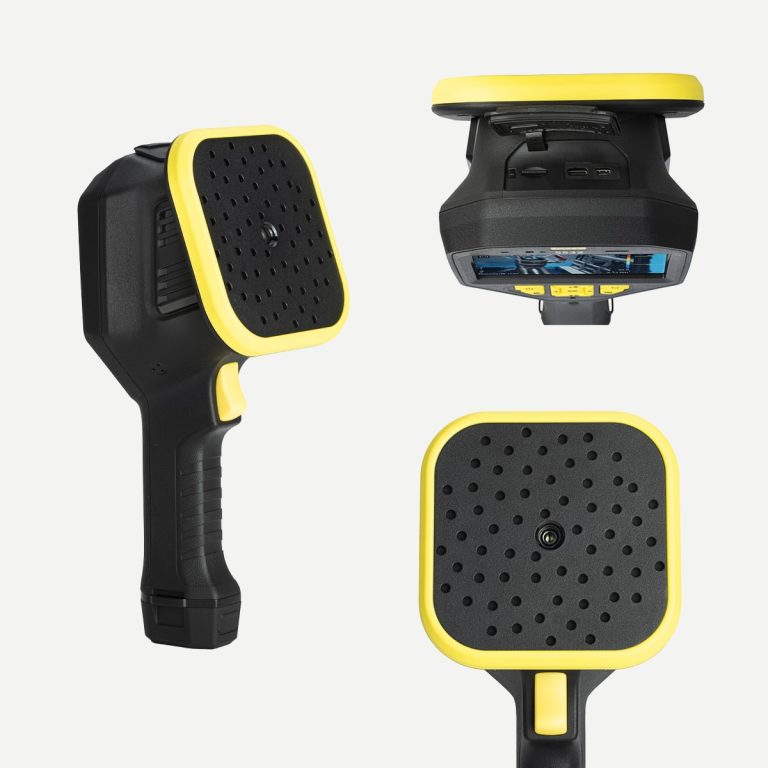
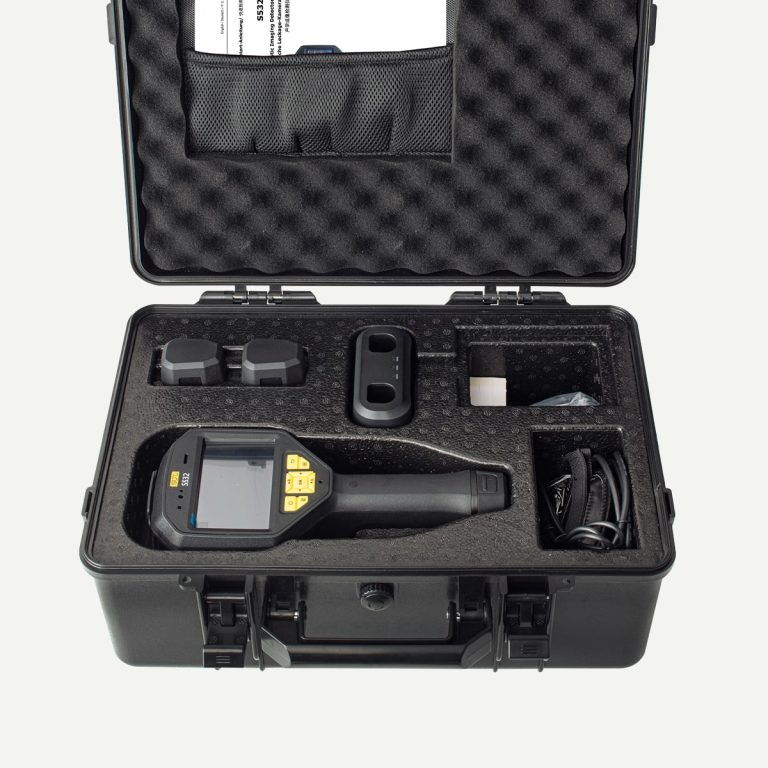
The S532 Acoustic Imaging Leak Detector is an advanced, professional tool designed specifically for industrial environments. It offers unparalleled sensitivity and accuracy in the detection and management of compressed air leaks and partial discharges.
Made in Germany. brand SUTO, model S532
Fast delivery to Latvia, Estonia and Lithuania. International delivery to Europe, Asia, Africa and other continents available on request
Our warehouse is located in Riga, Latvia.
Retail price from 7 900 €

Available

Official distributor in Latvia
Time-tested American, European and Asian brands of control and measurent instruments

Special price list for organisations
We offer a significant discount for trade organisations and manufacturing companies

Worldwide shipping on request
We take care of all logistics and customs clearance. Fast delivery to Baltic countries

After-sales service and support
Warranty service and repair, expert assistance in the operation of the instruments
The S532 acoustic imaging detector for compressed air leaks and partial discharges is a professional solution for industrial diagnostics. The instrument uses acoustic imaging technology to precisely detect and record leaks in pneumatic systems as well as electrical discharges at a distance of up to 100 m, ensuring that no critical fault goes unnoticed.
An array of 64 low‑noise MEMS microphones provides detailed scanning across a bandwidth of 0 kHz to 96 kHz with manually adjustable bandwidth range. This enables efficient operation both in standard pneumatic networks and in high‑voltage electrical installations by filtering out background industrial noise.
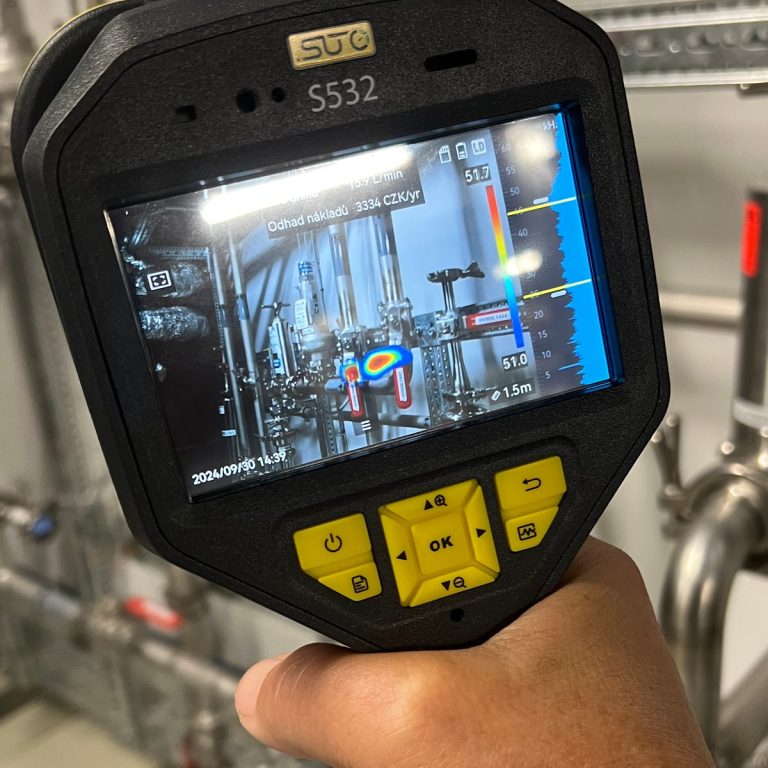
The 4.3″ LCD touch screen displays a real‑time acoustic image overlaid on a visual image, instantly indicating the problematic area. The lightweight housing and balanced ergonomics simplify working at height and in hard‑to‑reach locations. Data capture is performed by pressing the trigger button: a voice memo or text note can be added to each image.
Users can individually customize inspection parameters: cost per loss, currency units, sensitivity, detection distance, and frequency range. All collected data is automatically exported to the SUTO Leak Management Software (LMS) for generating detailed leak reports, financial analysis, and repair planning.
Timely detection of leaks and partial discharges prevents unplanned downtime, reduces the risk of damage to expensive equipment, and minimizes compressor energy consumption. The S532 becomes a key tool for improving production reliability, safety, and cost‑effectiveness.
Application
Benefits
Features
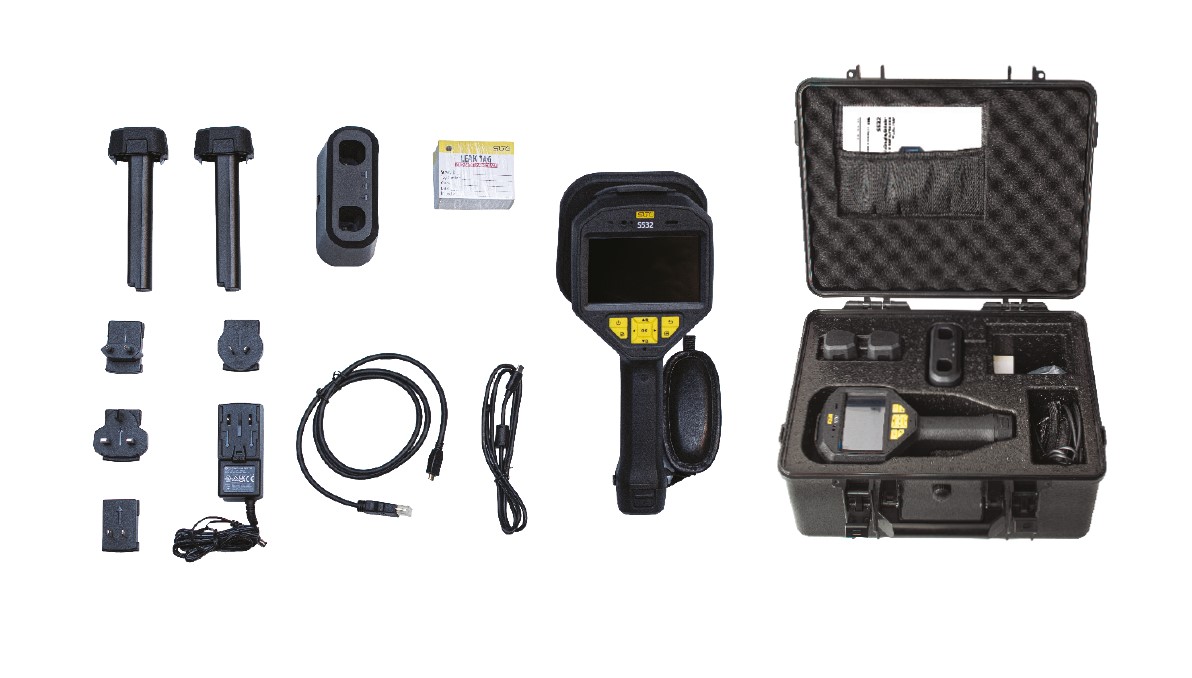
Scope of delivery
Acoustic imaging detector has multiple microphones which form an array detecting sound vibrations. Time difference exists when the sound signal is received at the mic array due to the mics’ different positions. Using this information, acoustic imaging detector can determine the direction and location of the sound. Using beam forming technology, it can strengthen the signal and weaken the interference between multiple collected sound waves.
Yes, it can. An acoustic imaging detector can be used to detect partial discharges including but not limited to corona discharge. The camera can identify more discharge types such as particle discharge, floating discharge, and surface discharge.
The distribution and number of microphones can affect the range and fineness of the detectable frequency. With the same microphone distribution, the more microphone in an acoustic imaging detector, the smaller the vibration (sound signal) can be detected, and the wider the effective detection range.
dB is the unit of sound intensity. The greater the sound intensity, the louder the sound. KHz is the unit of sound frequency. The higher the frequency, the sharper the sound. The dB value of Max displayed in the interface is the peak sound intensity within the specific yellow sound spectrum box. The longer the length of the blue stripe, the greater the sound intensity.
The typical frequency of a gas leak is between 25 KHz and 45 KHz. A real leak should be stable as long as the air compressors normally work. For practical use, you can use any one of the three preset frequency ranges to have a quick scan on the pipe and find an acoustic palette stably at a place. You should move the camera to change its viewing angle and confirm the palette is not a reflection. Then a leak is likely there in the pipe. If verification is required, safety is the priority. You may need other tools to double confirm.
S532 acoustic imaging detector can technically detect sound of frequency up to 96 kHz. For user experience, the upper limit showing on the sound spectrum is defined as 100 kHz. In practice, the higher the sound frequency, the much more the strength attenuation during transmission through the air. The differentiable signals among the background noises are usually less than 65 kHz. For experienced inspectors who are familiar with their inspection sites, they are likely to use several sound frequency ranges that they frequently meet during inspection works, and the zoomed range (0 – 65 kHz) would be more efficient for manually adjusting the yellow frame of detection range.
You can turn off Multiple Sources in the settings menu to find a single leak (the strongest leak) in a scene. Get start with the highest frequency range and widest detection spectrum (yellow box on right side of the camera interface). If no acoustic palette on the pipe during a quick scan with your camera, please lower the detection frequency (level) and repeat the scan, until an acoustic palette appears and stays somewhere on the pipe. Then narrow the yellow sound spectrum box (span) to minimize impacts from unstable sounds which are possibly noises.
Though acoustic imaging detectors don’t say the frequency of an acoustic palette, we can roughly know by the following steps.
Note: The target frequency is included in the spectrum range. The narrower the yellow box, the more accurate the estimated frequency.
The camera can provide many (more than 3) acoustic palettes representing possible leaks and their reflections caused by surroundings, when Multiple Sources in the settings menu is turned on. The detection algorithm ensures all presented palettes are in similar sound intensities. It’s not easy for a user to keep reflections away in a practical scenario, since a pipe is usually mounted near a wall, ceiling, or equipment that can reflect gas also forming acoustic palettes in the acoustic imaging detector.
For this reason, Multiple Sources is recommended to be off for the strongest source at a moment. One acoustic palette in a snapshot can clearly tell a suspected leak. One more snapshot with another acoustic palette on a different place tells another suspected leak. In this way, it is no longer a goal to find multiple real leaks against reflections and noises. The goal is to source the strongest, secondary, and weaker leaks in a scene with multiple snapshots. You can just change your position and angle your camera to physically avoid the found stronger leaks.
3 out of 5 is the default. The larger the number is, the more sensitive the acoustic pattern behaves. In a mid- or long-range scenario such as partial discharge detection, the sound source could be in 10 m away or even further. A high Sensitivity is helpful for displaying a weak signal as a palette in the camera screen. For a near-range scenario, sound is usually strong enough. The Sensitivity should be low. In practice, Sensitivity should be manually adjusted case by case. Please note that the more sensitive is, the more noise would be collected.
Distance works for compensation against attenuation when sound goes through the air before arriving at the microphone array in the acoustic imaging detector. Leak cost, leak rate, leak level, and discharge level are dependent on the compensation. Inspectors can roughly set a distance at the first scan, but it should be as accurate as possible after a stable acoustic palette shows in the camera screen for correct lost estimations.
Yes, it can. An acoustic imaging detector can be used to detect partial discharges including but not limited to corona discharge. The camera can identify more discharge types such as particle discharge, floating discharge, and surface discharge. It may tell noise if discharges are too weak or don’t exist.
An electrical system usually works in Alternative Current (AC) conditions, 50 times or 60 times (in different countries) in one second. Every time the applied voltage on a defect of an object would be up and down as time goes by, leading the defect discharges at a specific time and amplitude. The discharges form into a shape at a period and repeat 50 or 60 times in one second. The overlapped shape is the PRPD diagram in the acoustic imaging detector.
S532 acoustic imaging detectors can provide PRPD diagram and PD type identification such as corona discharge. Theoretically, the more the microphones and the higher the detectable frequency range, the more accurate the PRPD and PD type identification.
Tip1: Avoid reflections. Try to find an open place, avoiding walls, doors, desktops.
Tip2: Avoid environmental noises. Some machines (such as lawn mower, hand dryer) overwelmingly create noises. Inspectors should try to avoid these occasional factors during practical use.
Tip3: As strong as possible. Though weak leaks can be detected, but stronger noises from the background can appear and distract. The camera would display acoustic palettes on random noises instead of the designated sound generator. Please prepare a mobile App in advance in case the demo leaks or discharges are not strong or stable enough. Freqency Generator is a free mobile App in App stores.
The displayed strength indicates the discharge strength at the location of discharge.
Intensity Range is Auto by default, which takes the advantage of the detection algorithm to present the acoustic pattern of a proper size. The larger the pattern size, the more probable the pattern covers the strongest sound source. Intensity Delta is a parameter that users can specify after selecting the Auto and changing it to Manual.
An acoustic pattern is overlaid on the visual image and can block the interested target if the pattern is not transparent. For this reason, transparency should be available in various levels for different user preferences. The pattern would disappear when Level is 0, and 100% Level for complete blocking.
Can not. S532 supports digital zoom only.
No, because this is not a measuring instruments it’s an imaging detector, therefor no calibration required, just the standard production and out going test procedures.
Please open the Multiple Source Setting. And switch the intensity range from Auto (default) to Manual, and set the related Intensity Delta ( …10DB) number, which means the DB difference between the bigger one and the smaller one.
Step 1: Set the frequency range Settings > Acoustic Settings > Frequency > Select 0~65 kHz
Step 2: Set the frequency range to 2 from home screen, because typical frequency of a gas leak is within 25~45 KHz. Of course, customer can set the frequency range to their actual needs.
There are 3 types of ranges as below:
| ACOUSTIC | |
| Microphones | 64 low-noise MEMS microphones |
| Bandwidth | 0 kHz to 96 kHz |
| Distance | 0.3m~100m |
| Acoustic Image Palette | White Black, Black White, Rainbow, Fusion, Ironbow, Red Black, Rain, Blue Red |
| Dynamic Range | Low Limit: <-15dB High Limit: >120dB |
| Leak Rate | >0.008 l/min @ 6 bar from 0.5 m >0.013 l/min @ 5 bar from 1 m |
| Discharge Detection | Automatic detection 50 / 60 Hz |
| Discharge Type | Corona Discharge, Particle Discharge, Floating Discharge, Surface Discharge |
| DATA STORAGE AND COMMUNICATION | |
| Storage Media | Removable 64 GB SD Card |
| Image Storage Capacity | 20,000 images |
| Annotations | Voice note: max. 60 seconds; Text note: max. 255 characters |
| Video Storage Capacity | 60 hours |
| Video File Format | MP4 |
| GENERAL DATA | |
| Display | 800 × 480 Resolution, 4.3’LCD Touch Screen |
| Digital Zoom | 1.0x to 16.0x continuous |
| USB Interface | USB Type-C |
| HDMI Interface | HDMI-D |
| Battery Operating Time | Approx. 3.5 hours |
| Battery Type | Dis-mountable and Rechargeable Li-ion Battery |
| Battery Charging Time | 5 hours to full charge |
| Protection level | IP54 |
| Power Supply | 5V DC/2A (Charging via USB) |
| Working Temperature Range | -20 °C to 50 °C |
| Storage Temperature Range | -20 °C to 60 °C |
| Approvals | CE, UKCA, RCM, ICES, KC |
| Relative Humidity | <90 % non-condensing |
| Weight | Approx. 940 g |
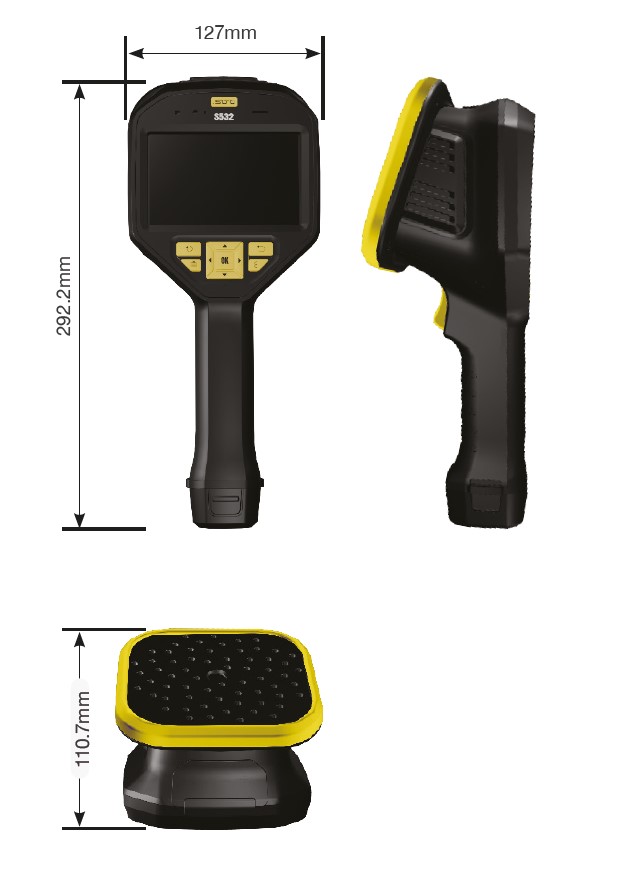
| Dimension | 292.2 × 127 × 110.7 mm (11.50 × 5.00 × 4.36 in) |
| Model | Description | Price, € |
| P601 0105 | S532 acoustic imaging detector set consisting of: S532 handheld acoustic imaging camera, 3 batteries, MIC protective case, USB cable, HDMI cable, SD card, charger, charging base, 100 leak tags, all in transport case. Including 1 LMS license for leak reporting. | 7900 |
| A654 0001 | Battery packs, exchangeable, set of 3 pcs., 3.6V, 6230 mAh (22.43 Wh) | 370 |
| A654 0002 | MIC protective case, protect the MEMS microphones | 10 |
| A654 0003 | Charger, input 100…240V AC, output 12 VDC, 2A | 30 |
| A654 0004 | Charging base, input 12 VDC, 2A | 190 |
| A654 0005 | Transport case S532 | 200 |
| A554 0122 | Leak tags to mark found leaks, 100 pieces | 20 |
| M599 7045 | LMS Leak Management Software, Local Installation, 1 License (bound to local PC), one-time payment. Note: 1 License is included in the Detector set. | 180 |
| A554 0133 | Ultrasonic Transmitter | 270 |
You can request the necessary certificates, documentation, instructions and user guide for SUTO S532 using the special form.
You can buy SUTO S532 in Latvia at a price starting from 7900 € in «OLIL SIA» by leaving a request on the website, by phone +371 672 70580 or by email olil@olil.lv. SUTO S532 price are subject to change depending on exchange rates. We deliver instruments by transport companies in Latvia, Estonia and Lithuania. Worldwide shipping to Europe, Asia, Africa, North and South America available on request.